
Introduction
In the UK, it is permitted to use rainwater (or recycled greywater) for:
- Toilets
- Washing machines
- Garden taps
Since those can add up to a significant proportion of the total water use, both the House and the Outbuildings were built with separate pipework systems to isolate those appliances which are permitted to use rainwater from those which are not.
There is a good overview of rainwater harvesting considerations in this 2010 Guide from the UK Environment Agency. Note that rainwater – while it might look clean – will be contaminated with bacteria and is not safe to drink. It is considered a “Category 5” contaminated liquid – the same as e.g. raw sewage. As a consequence, there are dark green warning labels attached to every outside tap and near the internal stop taps in both buildings. There are no warning labels on toilets since it seems a safe assumption that nobody will attempt to drink from those.
That 2010 Environment Agency guide includes the following text:
8.1 Carbon emissions
The carbon emissions that result from using a typical RWH system are, on average, around 40% greater than emissions from using mains water.
…
Research shows that for an average 90m2 semi-detached house with 3 occupants the split is 52% operational to 48% embodied emissions, excluding emissions from excavation and transport.
These conclusions are based on another 2010 Environment Agency document: Energy and Carbon Implications of Rainwater Harvesting and Greywater Recycling (Report: SC090018) which attributes the vast majority of the operational carbon emissions to the electricity used by the water pump, which is expected to work much less efficiently than the sort of pumps used at municipal water treatment plants.. More recent research (such as this 2020 Ricardo document: Independent review of the costs and benefits of rainwater harvesting and greywater recycling options in the UK) is much more favourable, including text such as:
Information guides published by the Environment Agency in 2010 and 2011, outlined the costs and benefits for domestic installations, but these are now largely out of date.
Experience to date is that the electricity used by the rainwater pump and its controller (measured by a dedicated sub-meter on their electricity supply) is almost exactly 1kWh per m3, costing 5p per m3 and with a carbon intensity close to zero. This very low electricity consumption is helped by:
- The expansion vessel on the pressure side of the pump, which services any rainwater usage below about 10 litres meaning that the pump only starts about 4 times per day and runs for longer when it does
- The very high efficiency Wisy Zeta 02 Pump Controller which claims a standby power consumption of only 0.2W, 97% less than some competing products
System Overview
Rainwater is collected from five downpipes around the inside of the Courtyard, which serve about half of the roof area of the Outbuildings. (Those downpipes intentionally connect straight into the underground pipework, not via open gullies with grids, to reduce the contamination getting into the tank. The downpipes which discharge into gridded gullies – as well as the threshold drains and the land drains – connect to the stormwater management pipework downstream of the rainwater tank.) The collected water is stored in the 5,000 litre underground tank with the large, round black plastic cover near the Stable Door. The associated controls and valves are housed in the adjacent Store Room.
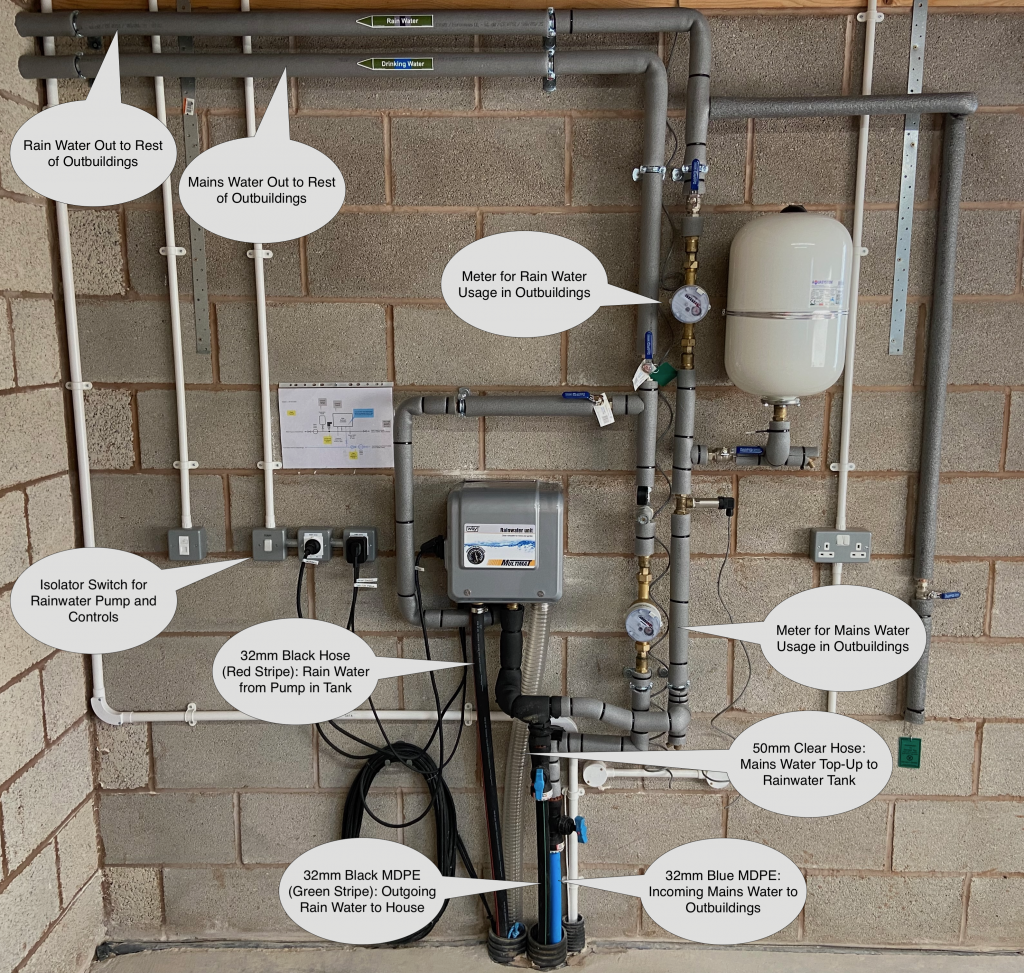
When there is a demand for rainwater (indicated by a drop in pressure in the pipework) the submerged pump in the underground tank is started by its pump controller (under the rectangular grey plastic cover). To avoid the pump starting for every single water draw-off, the pump ‘charges up’ the 24 litre white expansion vessel so often the demand is satisfied from this expansion vessel instead and the pump only starts when that is empty.1
If there is no rain for long enough that the underground tank gets too low for the pump to reliably operate, a float switch attached to the pump will open a mains water top-up valve which adds mains water to the tank via the clear plastic hose, ensuring the tank never runs out of water and the pump never runs dry. This does mean that the system does not provide complete exemption against hose pipe bans.
The tank needs to remain full enough for the pump to retain a good supply of water. The minimum volume is about 1,250 litres – meaning that the ‘working’ volume of the tank is reduced to about 3,750 litres. In a dry spell when a lot of water is being used in the garden it’s not difficult to use up all of this volume, causing the mains top-up to kick in.
Metering and Monitoring
There are water ‘sub-meters’ which track the usage of mains water and rain water in both the House and the Outbuildings.2 These help to:
- Show what proportion of the total water consumption is satisfied by harvested rainwater
- Report on any mains water leaks on the 600m of underground pipework between the Severn Trent billing meter on Snelsmoor Lane and the stop taps inside the buildings
- This isn’t automated in any way, since the Severn Trent meter readings are not easily accessible, but it is useful to compare the sub-metered mains water usage whenever Severn Trent send a water bill
All the water meters have M-Bus (Meter-Bus) reader heads and are automatically read every minute like all of the other M-Bus meters (for Heat, Electricity etc.). These readings are published as MQTT Messages and can be displayed in Home Assistant.
There is also a water level sensor immersed in the underground rainwater tank and a water pressure sensor which monitors the pressure of water in the rainwater pipework.3 These are both connected to the KNX Home Automation bus and their readings can be accessed via Home Assistant.
Finally, the electrical circuit feeding the rainwater pump and controls is fitted with an electrical sub-meter to monitor the electricity usage. The Wisy Zeta 02 Pump Controller is specifically marketed as a high efficiency unit, consuming less than 0.2W in ‘standby’ mode (though of course rather more when the pump is running) so this meter barely moves – typically incrementing by 0.1kWh every day or so.
Regular Maintenance
The main maintenance required is cleaning the filter inside the rainwater tank. This contains a fine metal mesh which tends to get blocked with a sticky, gritty residue from the gutters and once blocked it means any rainfall goes straight to the overflow rather than into the tank. It should be cleaned at least every 3 months.
The expansion vessel will probably need to be periodically re-charged with air. The usual trick of tapping the side of the tank will indicate how much of it is occupied by air versus water – and the pressure sensor is expected to also indicate when the pump pressure is no longer being maintained by the expansion vessel (when the pump starts for even the smallest water usage, rather than about 3 bars of pressure being maintained for 8 hours or so).
General Notes
- When making any additions or changes to the plumbing system it is imperative to ensure the separation between the two pipework systems is maintained. In the Outbuildings all the water pipes are exposed and there are identifying labels attached to the insulation on both sets of pipework. In the House, the mains water pipes are not marked but the rainwater pipes have labels attached to their insulation (though most of these are concealed behind plasterboard and flooring).
- The pump and controller, purchased from Wisy AG in Germany, were supplied pre-fitted with German-style electrical mains plugs. It seemed best to retain these and not to shorten the supplied electrical cables (hence the large coil of black cable attached to the wall) so there are two connections to German-style 230V socket outlets on the wall. Since these German plugs do not include fuses they are reliant on the overcurrent protection provided by a dedicated 16A circuit breaker which only feeds this one circuit.
- The rainwater pump is a single point of failure. While the Ebara Multigo unit is high-quality with a stainless steel enclosure that should last for many years, if it does fail then all rainwater supplies will stop until the pump is repaired or replaced. Toilets can still be flushed by pouring a bucket of (mains) water into the pan (or cistern) but the washing machine would be more problematic to temporarily re-plumb. Consideration was briefly given to allowing for some sort of ‘filling loop’ to deliver mains water via the rainwater pipework, but the rules for “Category 5” liquids make this problematic, since even double non-return valves are not considered suitable to provide the necessary separation.
- If the red ‘Failure’ LED shows on the Pump Controller (left-hand side of the Multimat unit, next to the pump cable socket) it means the pump did not delivered pressure when the controller asked for it. This LED will stay illuminated until the pump delivers pressure again. It is not an indication that the controller has failed.
- The pump is heavy (15kg) and must never be lifted by its power cable. Use the thin white rope attached to the lifting eye at the top of the pump – and then the delivery hose.
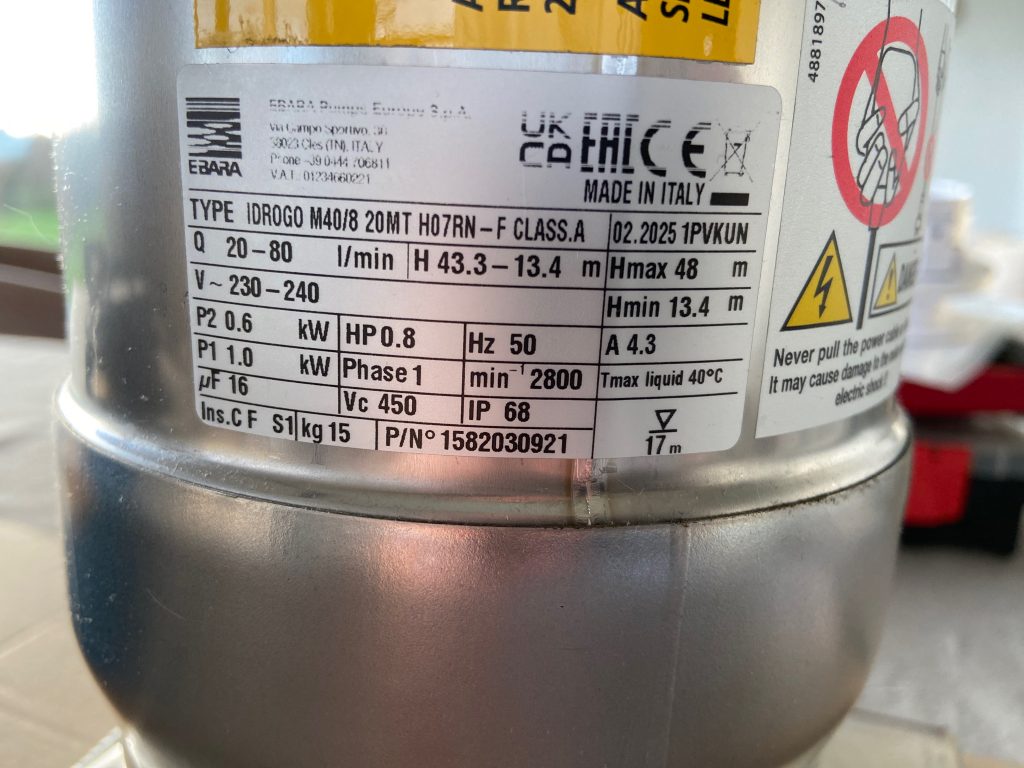
- The pump is an EBARA Multigo M40/08 single phase model – see the photo of its label below for full details. Identical replacements can be sourced from multiple suppliers in the UK, so there’s no need to purchase via Wisy in Germany (although a UK-sourced model might not come with a ‘German’ plug (or any plug at all) and a suitable plug might need to be retro-fitted).
- While the label clearly states “TYPE IDROGO M40/8” it seems the ‘Idrogo’ models are intended for use in wells or boreholes and have a bottom fitting allowing direct water entry. The ‘Multigo’ has a different base with a pipe inlet to connect to the floating strainer, but presumably the cylindrical section of the pump containing the motor and impellers is identical.
- Any replacement should be purchased as a Multigo M40/08 – for example via this listing at Pumps UK Ltd: https://www.pumpsukltd.com/ebara-multigo-m-40-08.html or local Derby supplier TF Pumps: https://tfpumps.com/product/ebara-multigo-40-8-1564040009/
- If the pump is removed from the tank for servicing it may empty itself of water and prove problematic to re-start. Lying the pump down horizontally at the bottom of the tank usually releases any trapped air as bubbles from the bottom plate. Re-starting the pump with it lying horizontal is a good approach – then pulling it upright using its white rope once it is happily delivering water.
- The pump draws in water via a floating strainer which sits a little below the surface of the water in the tank, where the water is typically cleanest. With this and with a new, clean tank there has been no problem with dirt appearing in the delivered rainwater. If that does become a problem – e.g. if specs of dirt are noticed on white laundry – then it will be possible to retrofit an inline filter system – either just for the washing machine or for all of the rainwater. Perhaps one of the ‘Hydra’ models from Atlas Filtri. Note that most Web searches for “Rainwater Filter” will return results for the filter on the inlet to the tank; it’s better to search for “Water Sediment Filter” instead.
- Sometimes you will hear a toilet cistern start to re-fill, then gradually stop, then start again when the pump kicks in. This is perfectly normal. ↩︎
- There is also a further sub-meter which tracks how much of the cold mains water in the House is consumed as Hot Water ↩︎
- The main use for this is expected to be showing the effectiveness of the expansion vessel in preventing frequent pump start-ups – and indicating when that needs re-charging with air ↩︎
 Rainwater Harvesting by Marsh Flatts Farm Self Build Diary is licensed under a Creative Commons Attribution-ShareAlike 4.0 International License.