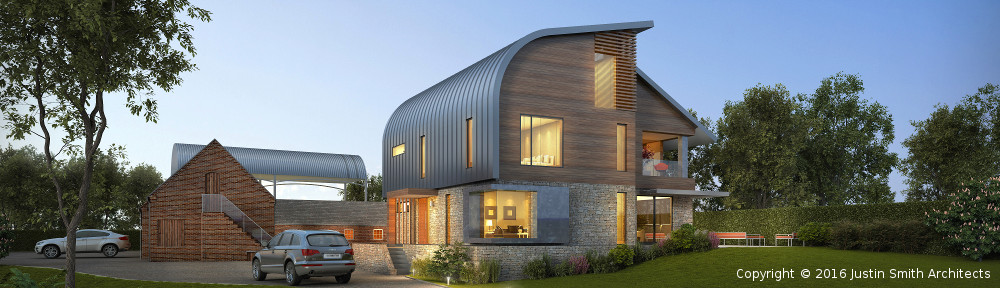
The concept for the Outbuildings has always been to construct the outside using materials as close as possible to what they would have originally used 100 years ago. This means the buildings will look ‘new’ (as opposed to using reclaimed materials to try to make them look ‘old’) but they will still appear ‘traditional’ – and hopefully not ‘fake’. The contrast with the modern-looking House is completely intentional.
Roof Tiles
For the roof tiles the choice was fairly straightforward: from old photos and examples of broken tiles in the demolition rubble it’s clear the buildings originally had small (10.5″ x 6.5″) clay roof tiles. Some of the examples found are red and marked ‘Rosemary’ whereas others are blue. The old photos kindly shared by a previous owner clearly illustrate that most of the original tiles were Staffordshire Blue – as can be seen in the photo below.

Using ‘blue’ tiles (rather than ‘red’) also means that the solar panels integrated into part of the roof will be less obvious – especially since the tiles with have a smooth finish, so will start their life looking slightly shiny.
The appearance of the roof is important because: a) there is a lot of it, and b) it will be very visible from the East-facing windows of the House – especially since the Outbuildings are (mostly) single-storey, with a floor level over a metre lower than the ground floor of the House.
There are some concrete roof tiles available which are finished to look like clay tiles; some of these are double-width with a fake ‘join’ in the middle and offer savings on both materials and (especially) on installation labour. However, those firmly fall into the ‘fake’ category – and are definitely not what would have been used originally.
The selected tiles are therefore machine-made plain, smooth clay tiles in Staffordshire Blue from Dreadnought Tiles in Brierley Hill (about 50 miles away).
Facing Bricks
For the bricks the choice was less clear-cut. Again there are old photos and plenty of examples of old bricks around the site which show the original bricks were an orange-red with quite a bit of variation in colour. It’s quite possible the originals were made at the old Chellaston Brickworks (that’s a PDF file link to a pamphlet from the Chellaston History Group) which was less than a mile away.
Based on the walls that were still standing in 2015, it’s evident many of the original bricks had weathered very badly over the years, which makes it difficult to tell what sort of finish they originally had.

However, in a few places, there were examples of bricks which were much less badly weathered (next to some that were still quite badly eroded) – which gives a better indication of what the original bricks might have looked like.

One brick manufacturer that is very visible within the self build community – especially since they always seem to have a presence at the self build shows – is Furness Brick, based in Cumbria. They still make bricks using traditional coal-fired kilns and hence naturally get colour variations based on where the bricks are located within the kiln. Their website is also very good at listing examples of buildings built using particular blends of their bricks, in case customers want to see a real-world example of what they look like.
The Furness bricks are expensive though – and not always readily available. They also have an even higher carbon footprint than bricks produced in a gas-fired kiln. For matching bricks when extending an original building they’re probably a good option, but for a new, standalone building there are alternatives which offer better value for money.
The main contractor identified the Clayburn Red Civic brick as being a suitable candidate and built a small test panel, using a couple of different styles of mortar pointing. This confirmed these bricks looked like a good match to the ‘best’ of the original bricks visible in 2015. While they might not suit a domestic building, they seem a very good choice for a semi-industrial agricultural building.

The original full planning Application didn’t specify the brick or tile materials and the resultant Approval included the expected Condition that these would need to be approved later. A formal Application to discharge this planning Condition was made in mid-February 2025 and formal Approval was finally granted on 22 April – after a bit of discussion and the sharing of photos of the original brickwork. The planning Approval confirms the choice of ‘bucket handle’ pointing.
