The Tesla Powerwall 3 integrated inverter-and-battery system is meant to be ‘smart’ in learning about solar generation and energy usage patterns, but it’s not proven to be as clever as I was expecting – notably in terms of Exporting from the Batteries to the Grid. One downside with the Powerwall is that its control algorithm is very much a ‘black box’ so it’s difficult to check if it’s working correctly – or even what “correctly” is expected to look like.
During the Winter, with modest solar PV generation and heat pumps running in both the House and the Outbuildings – plus all the other usual electrical loads – the Powerwall was effective in fully charging the batteries by Importing from the grid overnight, taking advantage of 6 hours of the Intelligent Octopus Go off-peak import rate of £0.07 per kWh and then using its battery to service all the electrical demand throughout the remaining 18 hours, generally avoiding all peak-rate Imports. Any solar PV generation – which could be significant on a sunny-but-cold Winter day – was Exported to the grid (in real-time).
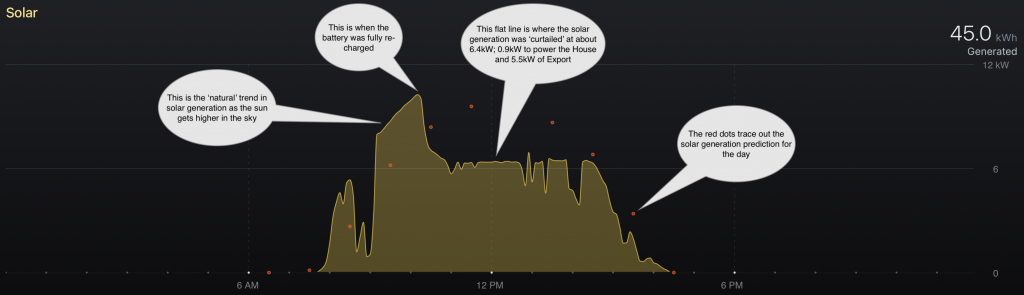
At the end of March, with the heating off and much more solar PV generation, that model is no longer appropriate. In particular, with the distribution network operator imposing an Export limit of 5.5kW but the potential to generate more than 16kW at Noon, there’s a requirement to temporarily store much of the PV generation in the battery and then export that in the evening – to create the headroom in the battery to accept further solar generation ‘tomorrow’. If that doesn’t happen, the solar PV generation has to be curtailed once the battery gets full.
My expectation was that the Powerwall would have visibility of a solar PV generation forecast for ‘tomorrow’ and choose to Export to the Grid from the Batteries in the evening, since it knew all the generation would never be consumed on-site. But that’s not been happening: the Powerwall never exported any of the energy stored in its battery.
Within the Tesla iOS App, I see options to set the Operational Mode, choosing between:
- Self-Powered, which “reduces the reliance on the Grid”
- Time-Based Control, which “uses stored energy to maximise savings”
I’ve also been seeing two Advanced Options:
- Permission to Export, which can either be Yes or No
- Grid Charging, also Yes or No
With both Permission to Export and Grid Charging set to Yes, in Time-Based Control mode I saw all the Solar PV Generation being Exported to the Grid (up to the Grid Export Limit of 5.5kW, with additional generation above that limit being used to charge the batteries). However, none of the energy stored in the battery (either from local solar PV generation or from an off-peak import from the grid) was ever exported.
Tesla’s documentation for the Advanced Settings in the Mobile App includes the following text:
Energy Exports
Some energy suppliers allow Powerwall to send energy back to the grid and claim credits during peak times. If ‘Energy Exports’ is not available in the Tesla app, your energy supplier does not allow Powerwall to export energy to the grid for any Time of Use purposes.
How It Works
If your Powerwall is allowed to send energy to the grid, the following energy export options will be available in the Tesla app:
Energy Exports Option Description Solar1 Powerwall will only export solar production to the grid during high-cost time periods. Everything Powerwall will export both solar production and stored Powerwall energy to the grid during high-cost time periods. When set to ‘Solar,’ your Powerwall will only use stored Powerwall energy to match your home load consumption when the price of energy is expensive. Use this setting if you want to earn credits while also keeping energy stored in your Powerwall to reduce reliance on the grid.
When set to ‘Everything,’ Powerwall will send both solar and Powerwall energy to the grid and will continue to discharge to your set Backup Reserve. Use this option if you want to maximise savings.
1 Default setting
However, I’ve not been seeing anything that looks like that Energy Exports option in the iOS App and – based on the behaviour I have been observing – the PowerWall has been acting as if that setting was on its factory default of ‘Solar’.
While investigating third-party control options to implement the behaviour I ideally wanted, I installed the Home Assistant integration for the Tesla Fleet API. (I’d tried installing that previously, when the Powerwall was first commissioned, but was thwarted by an obscure error. I finally got around to investigating why it failed and applying a work-around.) Unlike the Tesla iOS App, this integration exposes the Energy Exports options. I actually only spotted that because the setting initially defaulted to ‘Never’ and I was puzzled as to why the normal daytime export behaviour wasn’t working on the day after installing the integration. The names of the Energy Exports options in the Home Assistant dashboard for the the Tesla Fleet integration are slightly different from in the Tesla documentation:
- Never – which presumably equates to “Permission to Export” being set to No
- Solar only – which presumably equates to “Solar”
- Battery – which presumably equates to “Everything”
Initially I was hopeful that changing this setting via Home Assistant would influence the behaviour of the Powerwall, but that wasn’t the case. However, with the benefit of more experience of how the system has been operating and the clarity of the highlighted text in the Tesla documentation, I was fairly certain my unit had been commissioned with the wrong setting.
I contacted my installer, who contacted Tesla (who seem to be the only people able to correct configuration errors made during commissioning) and they changed the setting that was prohibiting export from the batteries. Now I’m seeing a third option under Advanced Settings in the Tesla iOS App, which is giving it permission to export from the batteries.
It looks like that setting was changed about 24 hours ago. As a result:
- The Powerwall barely charged from the grid during last night’s off-peak tariff period – even in Time-Based Control mode – meaning the battery had spare capacity to accept much of the excess solar generation during the daytime
- The Powerwall was aggressively exporting all through the early evening, maintaining the maximum permitted 5.5kW of Export even after the solar generation dropped to zero
- It’s only just now (at 20:00) started reducing the export to maintain enough charge to get it to the next off-peak import time slot (at 23:30) with the configured 20% ‘buffer’ of minimum charge to maintain, in case of a grid outage
So the behaviour has definitely changed – for the better. I’m expecting it to take a few days to re-learn the ideal behaviour and tweak its optimisations.