
The rainwater harvesting pump stopped working yesterday evening.
After a very dry spring and with a newly-planted hedge and a newly-seeded area of grass needing a significant amount of watering, the underground rainwater tank had emptied from a fully-filled 5,000 litres on 30th March to 1,300 litres on 26h April, with only 900 litres being replenished from rainfall around the middle of April.
After about 20 minutes of watering the grass seed using a hosepipe at around 8pm yesterday – while also running the ‘soaker’ hose along the hedge line – the water stopped flowing. First thought was that the pump had taken objection to running constantly for so long (though it had run for rather longer previously without any issues) but upon checking the pump controller its LEDs were all off; normally at least the green ‘Power’ LED is on.
Next thing to check was the circuit breaker (a dedicated 16A RCBO, supplying only the Rainwater Harvesting controls) – which had tripped. Upon resetting that it immediately tripped again. By that time it was getting late so further problem solving was left until the morning.
I’d made the decision to leave the supplied German plugs on all the RWH control units, connecting those to ‘Shucko’ socket inserts installed by the electricians, fed from the dedicated 16A RCBO via a 20A isolating switch. That made it easy to disconnect those plugs to try to isolate the issue (compared with if the plugs had been removed and the connections hard-wired). With all the plugs out there was no fault evident and the circuit breaker stayed ‘on’.
A quick check of the Pump cabling showed Live and Neutral had a suitably high resistance to Earth, though only about 5.5 Ohms between the two of them – which seemed a bit low, but not ridiculous for an electric motor. After reconnecting the Pump Controller and the Pump itself, the electrics were behaving fine but the pump wasn’t pumping. The red ‘Failure’ LED was lit on the Pump Controller, which is believed to be an indication the Pump had failed to supply pressure when powered up by the Controller. (I’ll come back to this later.)
There’s a second Schuko socket for the mains water top-up. That has a plug wired directly to the solenoid valve for the mains water supply which fits into a special intermediate adaptor plug which is wired to a float switch in the underground tank. The idea is that the valve stays unenergised (i.e. blocking the water flow) until the float switch closes (at low water level) – at which point the adaptor is made live and the valve opens. Plugging in the adaptor made the circuit breaker trip again. Checking the wiring inside the adaptor showed evidence of a short from Live to Earth, whenever the float switch was ‘closed’.
That explained the failure scenario:
- With slightly more than the minimum level of water in the tank, everything was working normally
- As water was used up, the tank level reached the minimum and the float switch switched – causing a short-circuit in the adaptor and tripping the breaker, thus removing power from the pump and stopping the water flow
The underlying issue turned out to be that the Adaptor has two sprung ‘clips’ which provide the Earth contact on the top and bottom of the inserted Plug. These clips move ‘outwards’ when the Plug is inserted and the lower one was very close to the wiring entering the Adaptor at the bottom. Evidently this clip placing pressure on a wire was enough (over time) to compromise the insulation and cause a short circuit. (It was the Blue wire which had failed. Normally that would be Neutral but here it’s acting as Switched Live.) The resolution was to leave none of the outer cable sheathing projecting beyond the cord grip, allowing the wires to be routed further away from the Earth clips, after the damaged wiring was cut off and re-terminated.
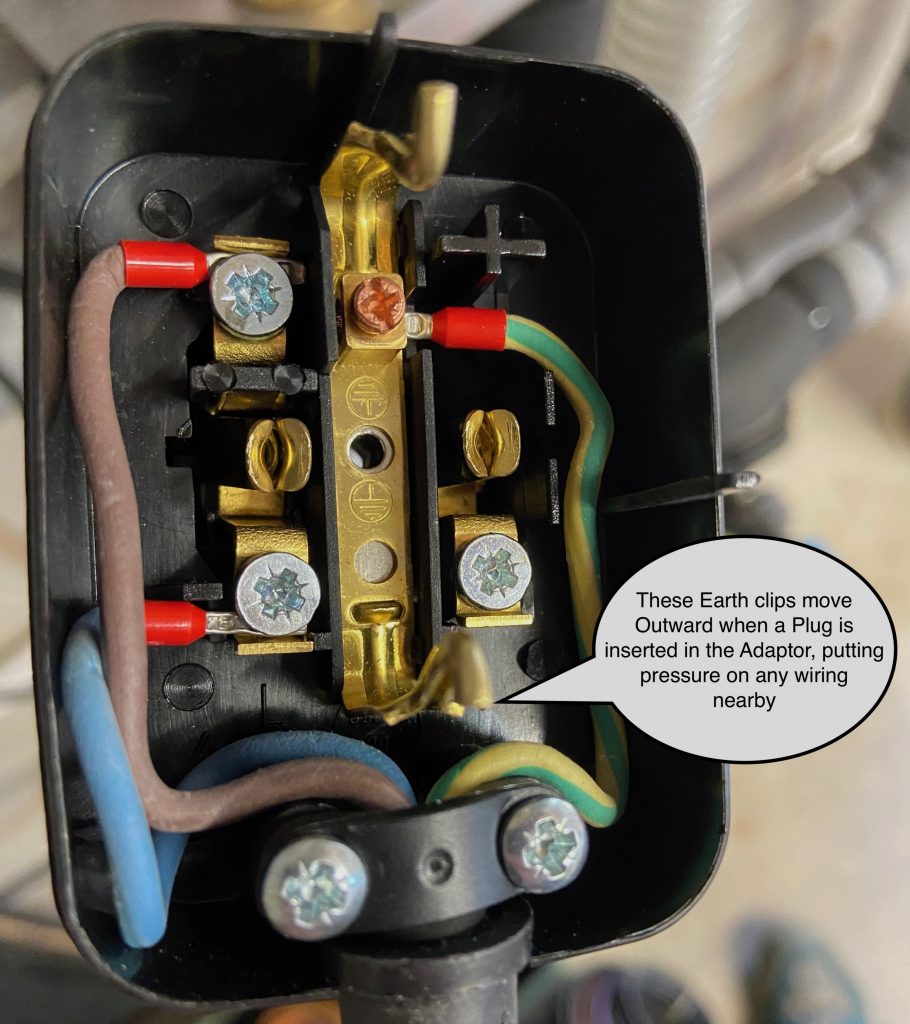
With the adaptor re-wired and re-fitted, the breaker stayed closed and the mains water top-up valve opened to add more water to the tank. I let it fill from 1,300 litres to 2,300 litres, which was enough to fully submerge the float switch (though that was still ‘closed’ – which is a separate problem).
I’m not entirely sure if the issue with the pump was caused by me removing it from the tank for inspection (letting air in and causing issues with it re-priming) or if it had separately had problems due to the low level of water in the tank. Even with an extra 1,000 litres of mains top-up it wasn’t managing to deliver any pressure when the Pump Controller powered it up. I could hear it trying to start pumping when the controller switched it on – I think it was spinning but ‘dry’ – but the overheat protection then kicked in (normally it gets cooled by water passing through its casing, past the motor windings). Tipping it over onto its side at the bottom of the tank let the air bubble out of the bottom, and it then started OK while still horizontal – and kept running when turned vertical again. I’m glad I left a ‘loop’ of pressure hose in the supply line to enable the pump to lie flat.
I’m still not sure what’s wrong with the float switch – which appears to be permanently ‘on’. Perhaps the switch contacts ‘welded’ closed due to the short circuit, before the breaker tripped (three times)? Wikipedia says the actual switching element is typically a regular microswitch, operated by a lever and a rolling steel ball (which you can hear). For now it’s easy enough to unplug the feed to the solenoid valve and keep an eye on the water level manually; maybe it will fix itself. There doesn’t appear to be any way to access the internals of the float switch without destroying its casing.
There’s finally been a bit of rain this afternoon. Only enough to add 400 litres to the tank – but at least the hedge and the grass seed don’t need watering today.
Update 2026-06-19
After allowing some time for the tank to re-fill from rainfall (to make it easier to re-prime the pump), a hot and sunny day seemed a good opportunity to get to the bottom of the float switch issue. I’d left the plug for the solenoid valve disconnected, but checking that periodically showed the switch was still ‘closed’ even with 4,000 litres in the tank – which isn’t right.
Removing the pump from the tank made it possible to check the details of the float switch – shown in the photo below.
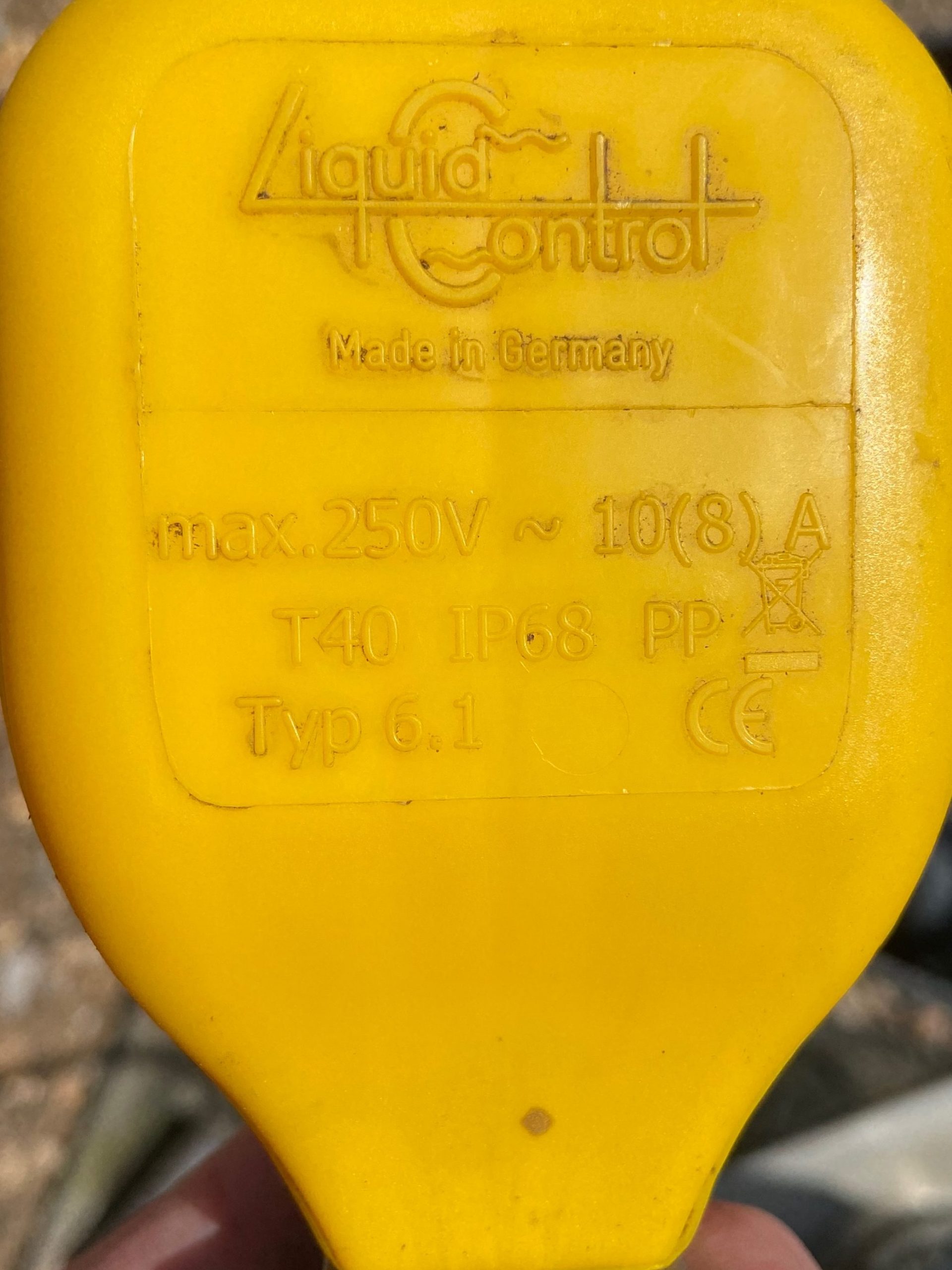
A bit of gentle shaking (moving the heavy ball inside the float) with the float still connected to its clamp around the pump had no effect – the switch was still permanently ‘closed’ – so I progressed to more vigorous shaking with the clamp removed from the pump. That did the trick, confirming my hypothesis that the switch contacts had ‘welded’ due to the brief short-circuit caused by the wiring fault.
The switch now seems to be working normally, and since it’s only handling a tiny load from the solenoid valve I’m relaxed about any long-term damage to the switch contacts.
Replacement float switches are available from Wisy and they’re a reasonable price – although buying one with 10m of cable adds significantly to the cost: https://wisy-water.com/en/float-switch-for-mains-water-top-up/
Update 2026-07-07
I’d been keeping an eye on the water level in the tank, with there having been very little rain recently. There was no sign of the mains top-up activating despite the tank level dropping to 1,200 litres but this evening, while putting several watering cans of rainwater onto the Horse Chestnut trees, it did kick in when the level reached 1,100 litres. It turned off again once the level sensor was reading 1,700 litres. The tank level sensor only reports in 100 litre increments (corresponding to a 20mm change in the tank water level) but the water meter on the mains supply to the Outbuildings showed that 778 litres of mains water had been added. (There was still a little draw-off of rainwater at the same time so let’s say the mains top-up adds around 750 litres before the float switch rises enough to switch off the solenoid valve.)
Update 2026-07-18
The automated mains top-up has kicked in a couple more times, as there’s been no rain for weeks. Each time the top-up ‘cycle’ has started at 1,100 litres and finished at 1,700 litres, so that seems fairly consistent. It generally takes 80 – 90 minutes to complete a top-up, which equates to very roughly 7 litres per minute of flow. I’ve noticed that the water pressure in the house (e.g. at the kitchen tap) is noticeably lower than usual when the top-up valve is open.
It occurs to me that during heatwaves, when the regional mains water delivery system is under stress, it would be better to schedule a top-up event when water demand is lowest – e.g. overnight. That’s not possible using the existing float switch (which only reacts to the water level) but could be arranged using some automation logic based on the reading from the water level sensor and a remotely-controlled electrical switch on the top-up valve.