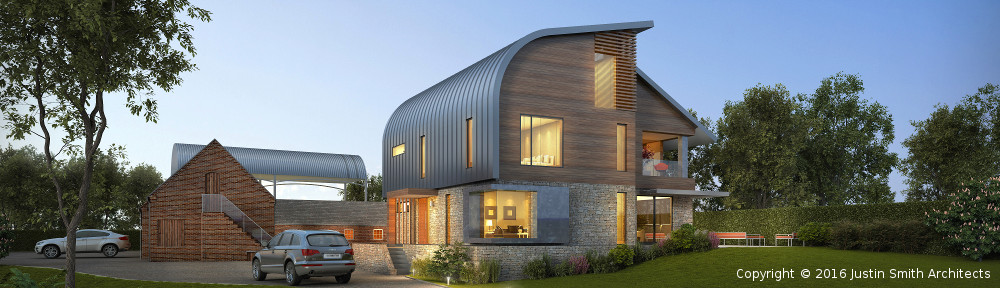
I’m using Ubiquiti UniFi network equipment in the House – notably for the PoE Network Switches and the Wireless Access Points. I find the UniFi gear provides a reasonable balance between Enterprise-grade functionality and Consumer-grade pricing.
The CCTV cameras are also from the UniFi product range – although those operate as part of the UniFi Protect sub-system and are largely independent of the underlying network equipment. I don’t currently use a UniFi network ‘Security Gateway’ since I prefer the flexibility of a more extensible router and firewall solution that I can add my own code to (I’ve recently moved to OPNsense) – though when the time comes to sell the house I might swap to one of the more user friendly UniFi gateways (and also replace the self-hosted UniFi Network Controller application, which currently runs in a Docker container on an Gen8 HP MicroServer).
It therefore makes sense to continue to use UniFi network equipment in the Outbuildings, managed via the existing UniFi Network Controller dashboard. The question is: which model from the extensive UniFi switch portfolio to choose?
The basic requirement is for at least 22 wired Ethernet ports, at least 13 of which need Power over Ethernet (for CCTV cameras, Wireless Access Points etc). That requirement maps nicely to a 24-port switch – although two 16-port switches would provide some redundancy and more expansion capacity.
- Second-hand US 24 250W PoE?
- That’s just a scaled-down version of the US 48 500W PoE switches in the house – which are OK but they’re relatively deep, and heavy – and the cooling fans are quite noisy (and would be far from ideal in the more dusty / gritty environment of the Outbuildings)
- These seem to go for around £175 on eBay – and might have been running 24×7 for many years so are likely to need new fans, if nothing else
- Two Gen2 USW-16-POE switches?
- These are fanless units (good) and have a 42W PoE budget (more than adequate) – but they only have 8 PoE-capable ports, so only16 from a pair – which is barely enough
- These also seem expensive compared to the 24-port variants – about £275 (inc VAT) each, brand new, so £550 for a pair
- One Gen2 USW-24-POE switch?
- These are fanless and have 16 PoE-capable ports (a much better proportion)
- They’re about £350 (inc VAT) each
- The main limitation is they only have regular SFP uplink ports – i.e. 1Gb/s max
- One Gen2 USW-24-Pro-POE switch?
- These have SFP+ uplink ports – i.e. 10Gb/s max – and all 24 ports are PoE+ (or PoE++) capable
- They have a 400W PoE power budget (much more than required) and they provide Layer 3 capabilities (e.g. a DHCP Server and inter-VLAN Routing) which can also be provided by the Firewall (which is required anyway, for other reasons)
- They’re over £600 (inc VAT) – which is a big premium to pay for features that aren’t currently necessary for this ‘domestic’ installation
On balance, the USW-24-POE seems the least-bad choice. While the 1Gb/s uplink is a limitation, the network link back to the house will be via two firewalls which also impose a 1Gb/s limit – until those are moved to more modern hardware. Second-hand (but relatively young) examples of the USW-24-POE occasionally appear on eBay – though typically for more than half the ‘new’ price.
If additional ports are required, a second (smaller?) switch can be added later – potentially in a ‘satellite’ location (avoiding the need to run all the structured cables back to the Plant Room).
One mitigation for the 1Gb/s uplink limitation would be to ‘aggregate’ both SFP ports for (a slightly better) 2Gb/s back to the adjacent firewall. Unfortunately, it seems that one of the three 1Gb/s ports on the PC Engines APU2 device that runs this firewall is currently refusing to run at more than 100Mb/s – due to some sort of hardware issue – so it’s stuck with one Gigabit connection to the House and one Gigabit connection to the Switch.