Brick and Tile Choices for the Outbuildings

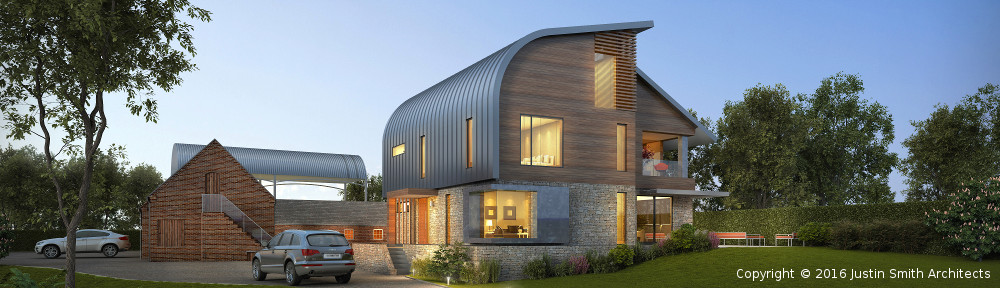
The concept for the Outbuildings has always been to construct the outside using materials as close as possible to what they would have originally used 100 years ago. This means the buildings will look ‘new’ (as opposed to using reclaimed materials to try to make them look ‘old’) but they will still appear ‘traditional’ – and hopefully not ‘fake’. The contrast with the modern-looking House is completely intentional.

Roof Tiles

For the roof tiles the choice was fairly straightforward: from old photos and examples of broken tiles in the demolition rubble it’s clear the buildings originally had small (10.5″ x 6.5″) clay roof tiles. Some of the examples found are red and marked ‘Rosemary’ whereas others are blue. The old photos kindly shared by a previous owner clearly illustrate that most of the original tiles were Staffordshire Blue – as can be seen in the photo below.

North-West corner of Barn, sometime in 1980s

Using ‘blue’ tiles (rather than ‘red’) also means that the solar panels integrated into part of the roof will be less obvious – especially since the tiles with have a smooth finish, so will start their life looking slightly shiny.

The appearance of the roof is important because: a) there is a lot of it, and b) it will be very visible from the East-facing windows of the House – especially since the Outbuildings are (mostly) single-storey, with a floor level over a metre lower than the ground floor of the House.

There are some concrete roof tiles available which are finished to look like clay tiles; some of these are double-width with a fake ‘join’ in the middle and offer savings on both materials and (especially) on installation labour. However, those firmly fall into the ‘fake’ category – and are definitely not what would have been used originally.

The selected tiles are therefore machine-made plain, smooth clay tiles in Staffordshire Blue from Dreadnought Tiles in Brierley Hill (about 50 miles away).

Facing Bricks

For the bricks the choice was less clear-cut. Again there are old photos and plenty of examples of old bricks around the site which show the original bricks were an orange-red with quite a bit of variation in colour. It’s quite possible the originals were made at the old Chellaston Brickworks (that’s a PDF file link to a pamphlet from the Chellaston History Group) which was less than a mile away.

Based on the walls that were still standing in 2015, it’s evident many of the original bricks had weathered very badly over the years, which makes it difficult to tell what sort of finish they originally had.

Very badly weathered original brickwork on derelict barns in 2015

However, in a few places, there were examples of bricks which were much less badly weathered (next to some that were still quite badly eroded) – which gives a better indication of what the original bricks might have looked like.

Less badly weathered original brickwork around one of the barn ventilation slots in 2015

One brick manufacturer that is very visible within the self build community – especially since they always seem to have a presence at the self build shows – is Furness Brick, based in Cumbria. They still make bricks using traditional coal-fired kilns and hence naturally get colour variations based on where the bricks are located within the kiln. Their website is also very good at listing examples of buildings built using particular blends of their bricks, in case customers want to see a real-world example of what they look like.

The Furness bricks are expensive though – and not always readily available. They also have an even higher carbon footprint than bricks produced in a gas-fired kiln. For matching bricks when extending an original building they’re probably a good option, but for a new, standalone building there are alternatives which offer better value for money.

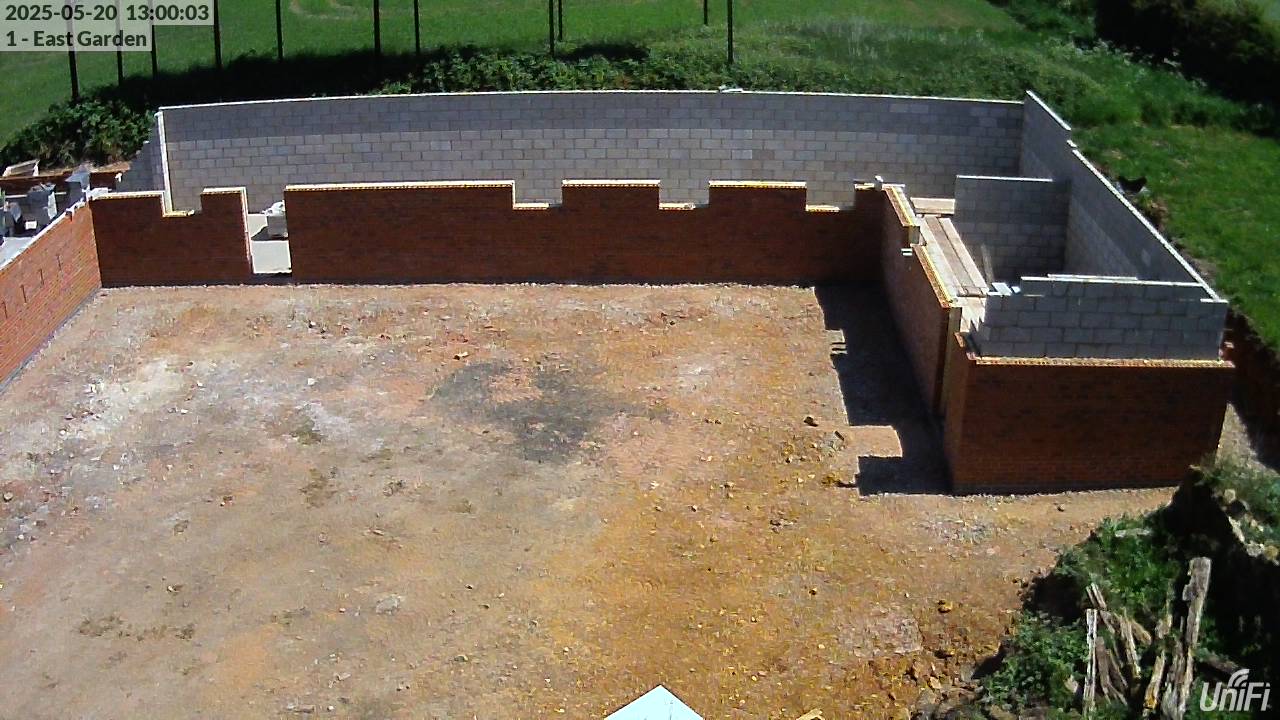
The main contractor identified the Clayburn Red Civic brick as being a suitable candidate and built a small test panel, using a couple of different styles of mortar pointing. This confirmed these bricks looked like a good match to the ‘best’ of the original bricks visible in 2015. While they might not suit a domestic building, they seem a very good choice for a semi-industrial agricultural building.

Test panel of Michelmersh Clayburn Red Civic Brickwork

The original full planning Application didn’t specify the brick or tile materials and the resultant Approval included the expected Condition that these would need to be approved later. A formal Application to discharge this planning Condition was made in mid-February 2025 and formal Approval was finally granted on 22 April – after a bit of discussion and the sharing of photos of the original brickwork. The planning Approval confirms the choice of ‘bucket handle’ pointing.

Home Battery Storage Sizing Calculations

The House has a 5.4 kWp solar PV installation dating from 2017 but no battery storage. The Outbuildings will be getting an 11 kWp solar PV installation along with battery storage. The question is: what’s the ‘optimum’ size of battery storage to install?

Winter-time Scenario

To some extent, this depends on the electricity tariff in use, but as a starting point let’s assume a tariff like Intelligent Octopus Go, which has a very low rate (currently 7p per kWh) for 6 hours a day (23:30 – 05:30) and a much higher rate for the remaining 18 hours.

A good approach is to size the batteries to be able to meet all of the electricity demand during the ‘peak’ hours by charging the batteries during the ‘off-peak’ hours. The worst case for that is in winter, when the heat pump is running and there’s little solar PV generation to offset the need for import during the peak hours.

(It’s fair to assume that electric car charging will be scheduled to happen in the ‘off-peak’ hours so it’s not necessary to account for charging electric car batteries from the house battery in this scenario.)

Looking back at the electricity bills for the 2024-25 winter period, the average daily import during ‘peak’ times was fairly consistently 19 kWh – i.e. just over 1kW on average for the 18 hours.

Clearly the Outbuildings will add to the electrical load and so increase that figure. Let’s assume a combined average load of 1.5 kW, requiring 27 kWh in total for the 18 hour peak-rate period (i.e. allow a ‘budget’ of about 450 W for the Outbuildings, to cover the MVHR unit, the Heat Pump, the IT kit etc.)

If the batteries are 100% charged at the start of the ‘peak’ period, and if they’re configured to permit discharge to 0% (which would be unusual) 27 kWh of battery capacity would just be able to satisfy the demand.

In practice, it is customary to limit the battery discharge to about 20% of capacity (to maintain a reserve in case of a grid failure – and also to help prolong the life of the battery, by not discharging it all the way to 0% on a daily basis) so 27 kWh of ‘usable’ capacity would need a battery set-up with a ‘nominal’ capacity of 33.75 kWh (80% of 33.75 kWh = 27 kWh). That’s 2.5 x 13.5 kWh battery modules.

If the combined average load was more like 1.8 kW (rather than 1.5 – i.e. allowing a budget of 750 W for the Outbuildings), that would equate to a battery set-up with a nominal capacity of 40.5 kWh – which would be 3 x 13.5 kWh battery modules.

Summer-time Scenario

The other key role for the battery storage is to be able to accept the ‘excess’ solar generation during the summer. The need for this arises because the maximum export permitted back to the grid (5.5 kW) is much less than the installed solar PV generation capacity (16 kWp).

The basic approach is to have the solar PV dump the excess power into the batteries in the middle of the day then export that back to the grid later in the day / overnight to stay under the maximum permitted export limit while still getting paid for the export.

On occasions when the solar PV array is operating at its absolute maximum peak capacity, we’re looking at:

  • 16 kW of solar PV generation
    • 11 kW from the ‘new’ panels on the Outbuildings plus 5 kW from the ‘old’ panels on the House
  • 0.5 kW of on-site ‘base load’ consumption
    • This might be higher – especially if electric car batteries need charging or the hot water tank can accept power via its immersion heater element – but in the worst case of an unoccupied house the usage will be no more than about 500W
  • 5.5 kW of maximum-permitted Export to the Grid
  • 16 – 0.5 – 5.5 = 10 kW of ‘excess’ generation that has nowhere else to go, so will be used to charge the batteries (provided those are not fully-charged already)

Clearly if generation at this level were to persist for long then even large batteries would fill quickly, but the 16 kW figure is an absolute maximum that will only ever be reached for a few minutes at solar noon – and then only under perfect generation conditions (no cloud cover and relatively cool temperatures).

Experience with the existing solar PV array shows that the peak generation in mid-summer is roughly 80% of the declared kWp value (even on cloud-free days – because those tend to be too hot to achieve maximum efficiency) – here’s an example from 2022, for the existing 5.4 kWp array on the House (which after 5 years was probably operating around 5.2 kWp).

Solar PV generation plot from the SolarEdge dashboard at the summer solstice in 2022

To better model the solar generation profile, we can approximate it as a sine wave – since we know the area under a half-cycle of a sine wave from 0 to π is 2 x peak value. The same graph above with an overlaid sine wave is shown below.

Generation data for 2022-06-21 combined with a sine wave model

At the summer solstice, the sine wave crosses the X axis at about 06:15 and about 19:45, which is 13.5 hours rather than π hours, so we need to multiply by 13.5 / π = 4.297, hence the predicted ‘cloudless day’ generation at the summer solstice is 2 x 4.297 = 8.59 times the peak value.

(This calculation closely matches the real-world data from the first graphic: on nearly cloud-free 2022-06-21 the existing solar array generated a total of 35.46 kW of electricity, with a peak of 4.1 kW.)

Since any generation less than 6 kW will be either consumed on-site or can be exported to the grid, the ‘problem’ is the generation above 6 kW, which will happen for up to about 9.25 hours (as shown in the graphic above). If the peak generation is 13 kW (i.e. 7 kW more than 6 kW) the total ‘excess’ generation during those 9.25 hours is: ( 9.25 / π ) x 2 x 7 = 41.25 kWh.

To store absolutely all of this generation would require batteries with a nominal capacity of 41.25 / 0.8 = 51.56 kWh – which would mean 4 x 13.5 kWh battery modules (for 54 kWh). However, experience shows that such ideal generating conditions rarely happen – for example the days either side of the summer solstice in 2022 were rather less good:

Total daily generation for 2022-06-21 and 3 days either side

On that basis, it would be unreasonable to design for this worst case scenario and instead tolerate some curtailment of solar PV generation if the battery ever gets full.

A further consideration is that the Outbuildings will have an Air-to-Air heat pump system which is capable of Cooling as well as Heating. On the very hottest days of the year, it might be sensible to run the heat pump in Cooling mode, which will consume some of the solar PV generation during the hottest part of the day.

Conclusion

It’s looking as if 3 x 13.5 kWh battery modules is the ‘best’ answer. There are technical merits in at least two battery modules (higher AC charging limits, for example) and the third module would provide enough capacity to run the site all-day in winter by charging the batteries overnight, at off-peak rates.

Another way of looking at things is to review the cost-effectiveness of the third battery pack:

  • 3 x 13.5 kWh battery packs, with a nominal capacity of 40.5 kWh / usable capacity of 32.4 kWh would be able to support all the anticipated winter-time consumption at 7p per kWh
  • 2 x 13.5 kWh battery packs, with a nominal capacity of 27 kWh / usable capacity of 21.6 kWh would require the import of ( 32.4 – 21.6 ) = 10.8 kWh at peak rate, costing an extra 18.4p per kWh, or £2 per day

£2 per day for every day in the heating season (6 months) is £365 per year saved by having the third battery pack.

In addition, there’s the ability to store additional excess solar generation on sunny days, getting paid to export that (at typically 15p per kWh) rather than not generating it at all. It’s harder to estimate how on how many days an extra 10.8 kWh could be generated, stored in the batteries and exported later, but if that was 150 days that’s an extra £243 – so potentially a total saving of around £600 per year from the third battery pack.