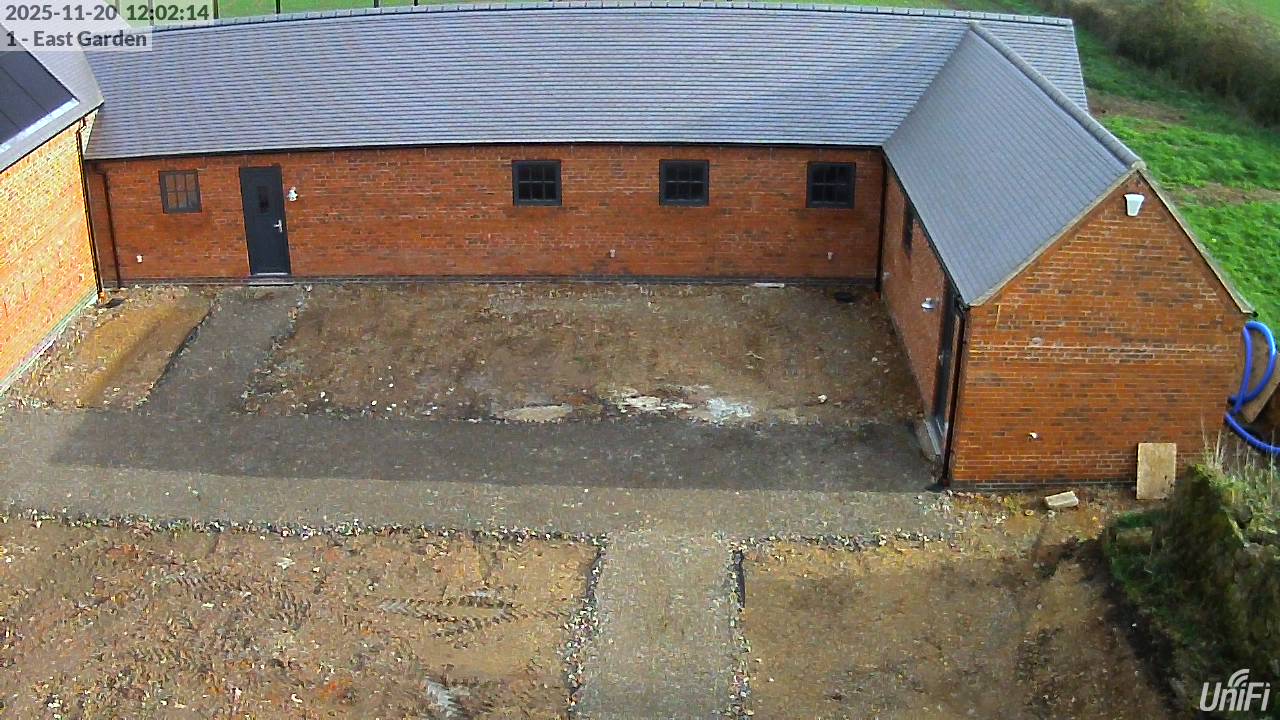
The floor covering team were back on-site, since they’re happy the self-levelling screed they laid on Monday has dried out enough for further work to proceed. They spent the day tidying up a few areas that weren’t as smooth as they’d like and fitted the ‘coved’ skirting and the capping strip that will cover the top of the vinyl. The weather has turned cold so it’s needing some heating in the Utility Room to make the flooring sheet pliable enough to lay and form up at the edges – ideally it wants to be 18C.
The plumber was back on site too, with the priority for them being the underground mains connections into the new building and removing some redundant underground pipe loops dating back to the House build. While those had been isolated via underground stop taps, it seemed unwise to trust those long-term, so the tee fittings were replaced with straight couplers. There’s just one more loop to remove tomorrow, once the hole dries out a bit more. Then two deep holes that have been open for a few weeks can be filled in.
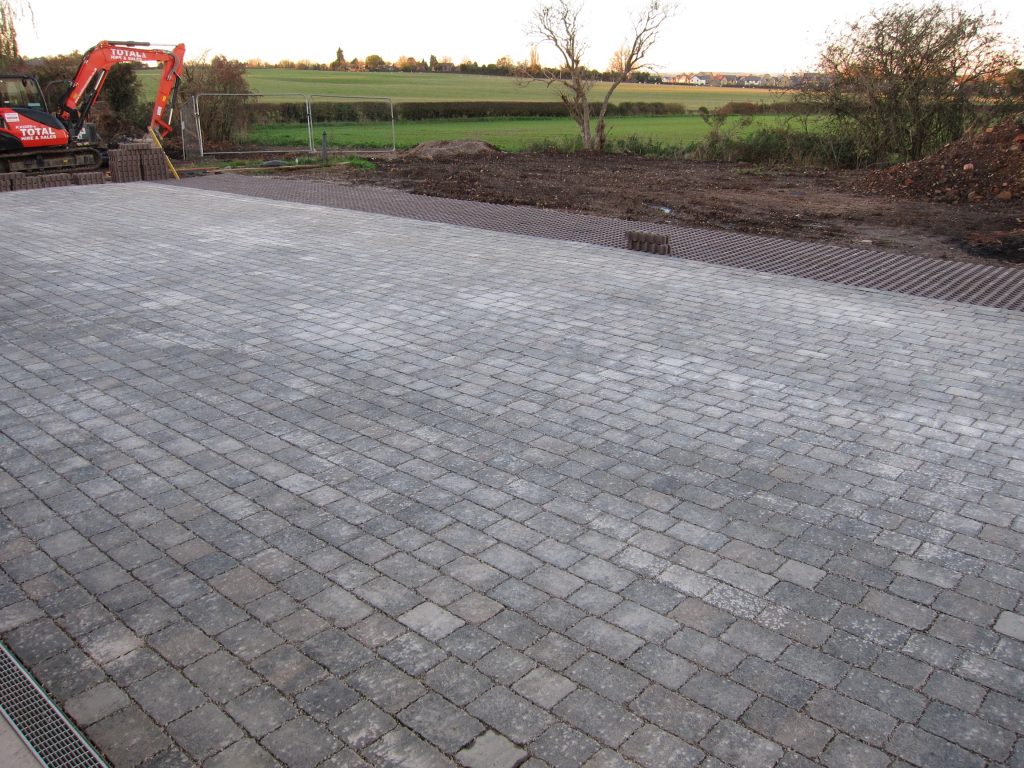
There was also more progress on the GrassGuard perimeter to the block-paved parking area, which is starting to look much closer to being finished.
Ongoing progress on the Marshalls GrassGuard perimeter around the block-paved area
A larger digger and a dumper truck were also delivered in preparation for the arrival of the replacement concrete headwall, which is due tomorrow.
One on the cold water supply to the bottom of the hot water cylinder, which measures the Hot water consumption (and needs to be subtracted from the incoming cold meter reading to leave the cold water usage)
One on the separate cold water supply to the potential-future-rainwater-harvesting pipework
This third one is actually fed from the incoming mains supply outside the house but might in future be connected to a rainwater harvesting system
Within the house, the pipework connected to this meter feeds the toilets, the washing machine and the outside taps (i.e. all the appliances which are permitted to be fed with harvested rainwater)
These meters are in addition to the water company’s ‘revenue’ meter and could be considered excessive, but:
The water company’s meter is about 600 metres away from the house so there’s a lot of underground pipework that could potentially leak (and which runs through fields which get ploughed) and it’s good to be able to cross-check the meter readings in case any leaks develop
It’s useful to be able to compare the Hot water usage with the Cold water usage – and to see how much of the water usage could potentially be displaced by rainwater harvesting
This is especially pertinent as I firm-up the specification for the Outbuildings, to be constructed as part of “Phase 2” of the building work, and compare the cost of a rainwater harvesting system with the potential savings
The three internal meters have M-Bus readers fitted and are automatically read every minute – along with all the other M-Bus readers in the house. (Reading so often is completely over-the-top for Water meters, but not for e.g. Electricity meters, and it’s easiest just to read all the meters on every read-cycle than to mess about reading different meters at different intervals.) Then, every month, I manually record the monthly meter readings (as reported by M-Bus) into a spreadsheet to look at a summary-level view and monitor trends in usage.
Over the past couple of months I’ve noticed the ‘rainwater’ meter showing much higher readings than before, which seemed odd. On the 1st of May, the usage was up a bit; on the 1st of June the usage was up a lot – roughly 10 x the usage in February, for example. Initially I suspected a leak but on checking further it was clear the meter reading wasn’t changing unless there was obvious water usage.
Then I realised what was happening: it’s not that the meter is now reporting ‘high‘ – it’s that the meter has previously been reporting ‘low‘. The dials on the meter are showing 114 m3 but the M-Bus adaptor is reporting 85 m3. Plotting a graph of the meter readings over time (that I don’t normally do) makes it clear that something went wrong around the end of April 2022 that got fixed around the middle of April 2024.
‘Rainwater’ Water Meter readings, early 2022 through to mid 2024
I know what I did to ‘fix’ it – I’d been checking the details of the meter to be able to match it in the new building and removed and re-fitted the M-Bus adaptor. I don’t know what I did to ‘break’ it – but given that some readings were still coming through I presume the adaptor was knocked slightly out of position. (If it had stopped reading completely I would have spotted it.)
The meters are Itron Aquadis models with Cyble M-Bus adaptors that slide into some slots on the front of the meters – but they don’t clip into place hence they’re reliant on friction (or gravity) holding them in position, and they can get knocked.
[2026-01-28 Update: Actually the Cyble adaptors are intended to be fixed in place with a screw which hadn’t been fitted – although one of the three adaptors had the right screw loosely inserted. These screws have an M4 thread 25mm long with a ‘Cheese’ Head and are made from Nylon. Also, there’s a ‘cap’ covering the brass thread insert they screw into which needs to be destructively removed to expose that thread. With that screw properly fitted the adaptors are kept in the correct alignment.]
Now the problem is that the internal registers on the M-Bus adaptor don’t match the dials on the meter and there are no buttons or display on the M-Bus adaptor to make any adjustments – so it’s a case of using the Cyble M-Bus software that I originally used to set the M-Bus IDs to re-set the reading from the dials.
This was easy enough – once I’d worked out the Cyble M-Bus software needs to run as Administrator. Changing the reading is as simple as clicking on the digits and entering the new reading.
Screenshot of Cyble MBus v1.4 software
I’d forgotten these adaptors have the option to report against a Leakage threshold value; what’s not clear is how the detection of a ‘leak’ gets reported – there no obvious ‘leakage’ field in the XML data record that comes back to the M-Bus reader.