An earlier Post outlined the plan to use a GL.iNet GL-S20 Thread Border Router in conjunction with Ikea TIMMERFLOTTE temperature and humidity sensors to monitor the environment in various rooms in the Outbuildings, using Matter-over-Thread technology.
The GL-S20 arrived from China on 30 November, exactly one week after ordering. It’s as good as I was expecting and works perfectly when running from PoE, consuming just 1.34W (as reported by the UniFi PoE network switch).
Setting it up as a ‘Leader’ for a Thread network was pretty straightforward, using its Web interface. Configuring it in Home Assistant was a bit more problematic – it showed up straight away as an “Other” Thread network (since it’s on the same subnet so mDNS “just works”) but it wasn’t obvious how to make it the Preferred Thread network. The answer came from this forum thread which says to use the GL-S20 Tool iOS App which can grab the credentials from the device, then the Home Assistant iOS App can upload those to Home Assistant. It took a few attempts to get the GL-S20 App to find the device on the network and then to copy the credentials, but it worked in the end and now Home Assistant sees the Thread network as “Preferred” – which means it should use it by default.
It also looks like the TIMMERFLOTTE sensors are getting closer to being available to purchase in the UK. They’re now listed on Ikea’s Swedish website, for 79 SEK which is about 7 GBP. That price doesn’t include the necessary AAA batteries but the sensor is specifically designed to use two 750 mAh rechargeable AAA cells and Ikea sell a good range of those.
Update 2025-12-09: The TIMMERFLOTTE sensors are now listed on the IKEA UK website and are showing as in-stock at my local store, for £5 each.
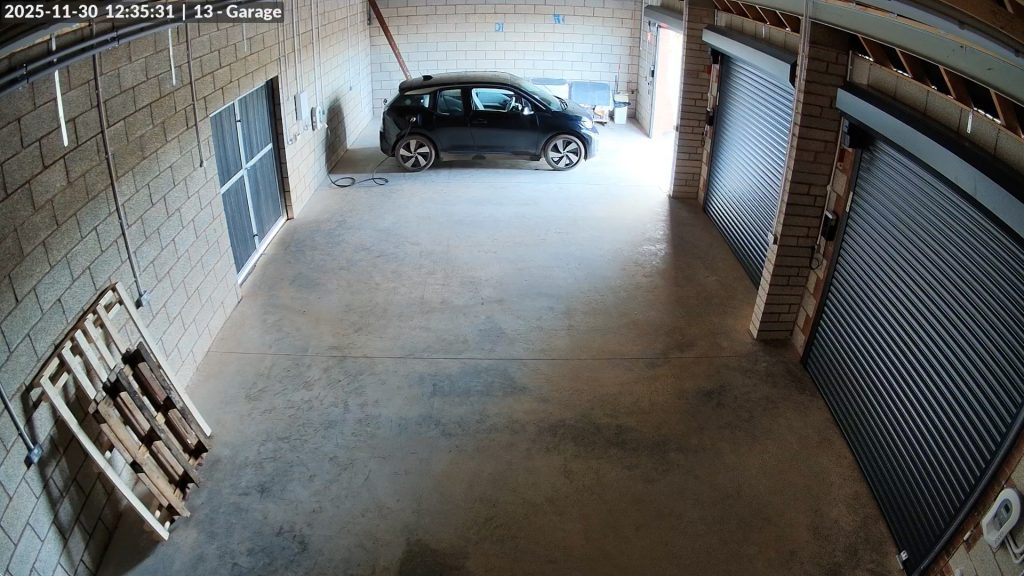
Now the parking area is accessible to cars and with it being forecast sunny for most of the day, it seemed a good opportunity to put the electric car in the garage for the first time and test out charging it with the Myenergi Zappi EV charge point, using excess solar generation that probably wouldn’t fit in the PowerWall battery and would hence be curtailed.
BMW i3 EV in the Garage, connected to one of the two Myenergi Zappi EV Charge Points
The BMW i3 looks a bit lost when viewed from the CCTV camera that monitors the garage. The plan was always to park that car there, which influenced the location of the ‘primary’ Zappi EV charge point at the back of the Garage, between the first and second parking bays. (The ‘secondary’ Zappi is just visible at the bottom-right of the photo, where it can be used from the third parking bay and for cars parked outside.)
One of the key features of the Zappi unit is that it can harvest excess solar generation and charge a car at a variable rate to make best use of the solar generation that would otherwise be exported (or curtailed – depending on the configuration settings). While it’s useful to have this capability, with both a house battery and a decent export tariff it will typically be more economical to charge the car on the off-peak overnight rate and get paid to export solar generation during the daytime – except when there’s more solar power than can be exported or used to charge the house battery1.
With the PowerWall having a DC-connected battery integrated with the solar PV inverter, it’s not possible for the Zappi to tell whether power coming from the PowerWall (which it monitors using a CT clamp) is originating from the solar panels or from discharging the battery. It has a second CT clamp on the main grid connection, so it does know whether the site is Exporting or Importing overall – but the Zappi manual admits to the limitations in such circumstances.
With the Intelligent Octopus Go tariff, Octopus get to control when the car charges – and will either do this in the normal overnight off-peak period or they will add an ‘extra’ off-peak period if they decide to charge the car at other times. Before having the Zappi it was necessary to have Octopus control the car via the BMW API but now it is preferable to have them control the charger instead2. Right now – even when deleting and re-adding the Electric Car ‘device’ and when telling them there is a Zappi charger, they still want to control the car. I’ve submitted an online form which is meant to ask them to control the charger instead – for which they’ll ask for the Myenergi account details, not the BMW account details. The form said to allow up to one working day for that to take effect, so I’ll try re-adding the ‘device’ in a day or so.
The other configuration setting that needs attention before allowing Octopus free rein over overnight EV charging is the “Import Limit” for the PowerWall 3. Right now there’s no import limit set so there’s a risk of:
Octopus charging the electric car at 7.5 kW
Tesla charging the PowerWall battery at 8 kW
The House drawing 3.5 kW or more if both heat pumps are running
That would make a total of 19 kW or 82.6 A at 230V, which is more than the rated capacity of the DNO fuse on the grid connection and it would be A Bad Thing to have that fuse blow3. Given that the PowerWall is enforcing the grid export limit we might as well have it enforce the grid import limit too (by slightly reducing how aggressively it charges its batteries from the grid).
It should be rare to have ‘too much’ solar generation like this once the charging algorithm for the house battery can be made to leave enough room for ‘tomorrow’s’ forecast solar generation ↩︎
This should mean that any scheduled pre-conditioning ahead of a future journey won’t be affected, whereas that schedule gets wiped when Octopus control charge scheduling using the car API. It should also prevent the car charging for a few minutes whenever it’s plugged in. ↩︎
There’s another 80 A fuse in the PowerWall Backup Gateway, which might blow first and is much easier to replace ↩︎