
Before the Tesla Powerwall 3 was installed, prior approval had to be obtained from the local Distribution Network Operator using the “G99” procedure, since the system exceeded the 16A-per-phase limitation of the notify-after-install “G98” procedure. The DNO reviewed the constraints of the electrical supply to the site and specified a maximum Export limit of 5.5kW – the same as they had specified in 2016 for the original solar PV system. Since the generation capacity is now large enough to be able to exceed that limit, there needs to be a device within the installation to ‘enforce’ the limit to the required standards, which the Powerwall 3 is certified to be able to do without relying on third-party components. The limit is configured at commissioning time and can be seen but not updated by the home owner, in the Tesla App. (Post installation it can only be changed by Tesla Technical Support, who presumably need evidence that the DNO has agreed a different limit – which might happen if the local grid infrastructure gets upgraded.)
The Powerwall 3 is also able to enforce an Import limit. This was not set at commissioning time but – given that the feature exists – it seemed prudent to make use of it. The supply is a ‘standard’ UK single phase connection with a nominal capacity of 15kVA, fitted with an 80A main fuse. Some simple calculations showed that simultaneous charging of an electric car (at 7kW) and the Powerwall battery (at up to 8kW) coupled with the GSHP running a heating cycle (at 2kW) and a modest 1kW of consumption by other appliances – coupled with no solar generation – would result in an import of 18kW, or 78A at 230V, which is too close to the 80A fuse limit for comfort. (These fuses will tolerate quite a bit of overload but having a main fuse blow is highly inconvenient.)
At my request, my installer had Tesla Technical Support configure a 17.5kW Import limit which has been in effect since December 2025. (17.5kW equates to 76A at 230V.) The expected behaviour is that the Powerwall will reduce its charge rate to stay within this import limit – which of course only works if Powerwall battery charging is a significant component of the total load. I’ve not been aware of this limit ever being reached, but it came very close today when Intelligent Octopus Go scheduled a car charging slot from 11:30 – 12:00 and the Powerwall took advantage of the temporary off-peak tariff to charge its battery. This happened to coincide with the GSHP running a heating cycle while there was also surprisingly little solar generation, given that it was so close to noon. (The IOG scheduling of the car charging at 11:30 was surely done with the expectation of significant solar generation – though not necessarily on-site.)
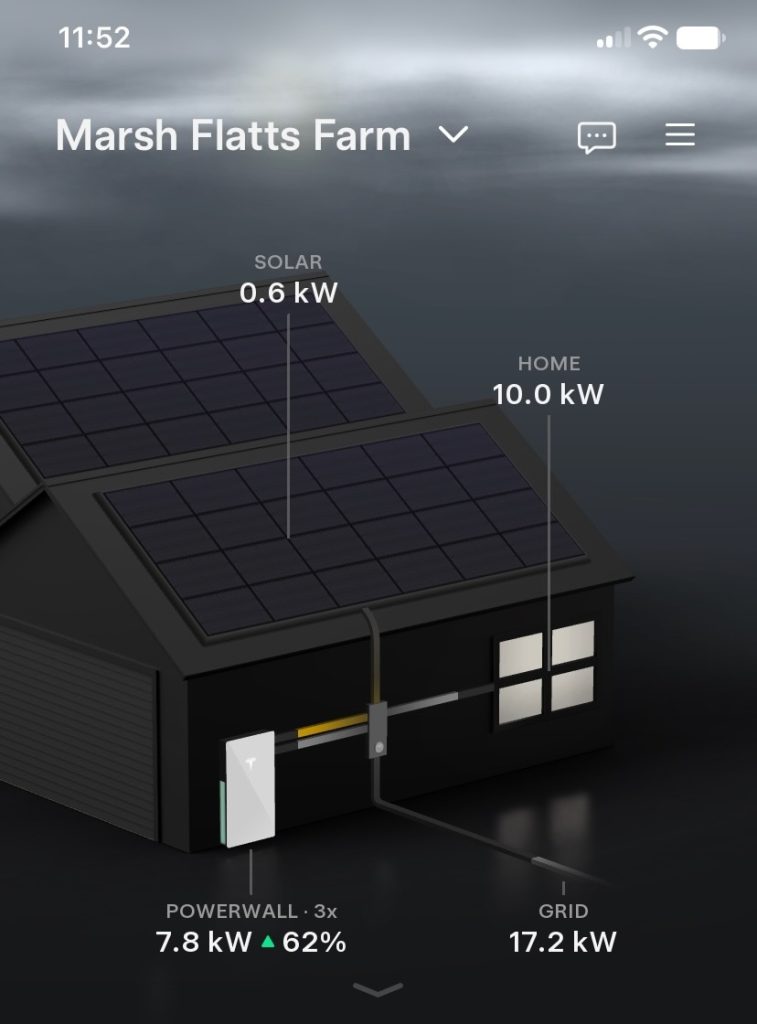
These heavy loads only actually overlapped for about 15 minutes but – given the time of day – there was plenty of scope for a brief additional load too (such as one of the instantaneous water heaters or a cooking appliance). It’s good for peace of mind to have the 17.5kW Import limit in place.
The myenergi Zappi EV charge point has a CT clamp on the main supply cable and is also able to adjust its charge rate to stay within a site Import limit – assuming EV charging is contributing to the load. This is primarily intended for when multiple Zappi chargers are operating simultaneously but also works when only one is in use.
One thing I’d not previously considered is the effect of such a large import current on the voltage drop in the supply cabling. Within the House the voltage measured 225V at 11:52 whereas it was 242V at both 11:25 and 12:15. 225V is still within the permissible limits (currently 216V – 253V) but that’s still a significant and quite sudden swing in voltage. Setting an Import limit is probably worthwhile just to manage the voltage drop, even if there is no risk of overloading the main fuse.